You know that pair of earrings selling for $25 at the boutique downtown? Someone bought it for $0.80.
That’s wholesale fashion jewelry — trend-driven, non-precious jewelry bought in bulk at near-factory prices, then resold at 3–10x markup. The whole game: buy low from a wholesale jewelry supplier, sell high to your own customers.
Simple. Absurd margins. And completely learnable — which is what this guide is for.

Why This Market Is Worth Your Attention in 2026
Look around. Fashion jewelry is everywhere — your Instagram feed, Etsy, that weekend market downtown. It’s not a fad. In fact, it’s a $30B+ machine.
Allied Market Research sized the global costume and fashion jewelry market at $31.7 billion back in 2023, growing about 6.4% a year. That was three years ago. Since then, however, TikTok Shop happened. Live selling exploded. If anything the growth accelerated — I haven’t seen a single credible signal of slowdown.
Here’s what most people get wrong though. They think the money is in buying jewelry. It’s not. It’s in buying it at $0.80 and selling it at $25. Wholesale to retail. That’s the entire game.
My DMs are full of the same questions, week after week. Usually from someone who’s been thinking about this for months but hasn’t pulled the trigger: “What even counts as fashion jewelry?” “How does wholesale pricing actually work — because there’s no way the listed price is the real price?” “Do I really need to order 500 pieces to start?” “How do I avoid getting scammed?”
All fair. All answerable. Let’s go through them with real numbers — no guru fluff.
What Exactly Is Wholesale Fashion Jewelry?
For example, my cousin cornered me at a family dinner last year. “So you just… buy jewelry cheap and sell it expensive?” I laughed. Then I said, “Roughly, yes. But the ‘just’ is doing a lot of heavy lifting in that sentence.”
Wholesale fashion jewelry means trend-driven, non-precious jewelry bought in bulk at close to factory cost. We’re not talking about the $800 gold necklace here. We’re talking about the $1.20 steel hoops that sell for $14 on Etsy. Different universe.
The word “wholesale” just means you skip every middleman between the factory door and your store. No distributors taking 30%. No importers adding their markup. You, the factory, done. That’s where the margin lives — in the layers you cut out.
Fashion Jewelry vs. Fine Jewelry
People mix up wholesale fashion jewelry and fine jewelry. Quick way to tell them apart:
|
Fashion Jewelry |
Fine Jewelry |
|
|---|---|---|
|
Materials |
Base metals, alloy, plated gold/silver, stainless steel, zircon |
Solid gold, sterling silver, real gemstones |
|
Price point |
$0.30 – $30 per piece |
$100 – $10,000+ |
|
Lifespan |
6 months – a few years |
Decades, often heirloom |
|
Target buyer |
Trend-followers, gift buyers, daily wearers |
Weddings, investment, milestones |
See the difference? Wholesale fashion jewelry is the fast-turnover zone. A TikTok trend can wipe out a SKU in a week. Nobody’s passing these down to their grandkids — and that’s the point. As a result, constant rotation means constant reorders. For a reseller, repeat purchases beat one big sale every time.
Materials You’ll Run Into When Sourcing
Open any wholesale fashion jewelry catalog and you’ll see the same seven materials on repeat. Here’s the unfiltered version.
Alloy, aka base metal, is the cheapest you’ll find. Usually plated gold or silver over the top. It works for those ultra-trendy pieces that’ll be irrelevant in three months anyway. Don’t expect heirlooms.
The Workhorses: Silver, Steel, Titanium
Then there’s 925 sterling silver. Notably, the “925” stamp actually means something to mid-range buyers — it’s the trust signal. Holds up well, decent margins.
Stainless steel — 304 or 316L if you want to get specific — is my personal pick for starter inventory. Tough. Hypoallergenic. Basically indestructible for daily wear. I’ve had almost zero complaints on steel pieces in years. Seriously.
Titanium steel goes even harder than stainless. Men’s rings especially — guys beat up their jewelry, titanium survives.
Coatings and Stones
Similarly, brass with PVD coating is worth knowing about. PVD is the modern plating method, way more fade-resistant than old electroplating. If a supplier brags about their PVD process? Good sign. They’re investing in quality.
Meanwhile, copper shows up as the base under higher-end plated pieces. Heavier in the hand, which customers read as “quality” even if they can’t articulate why.
And zircon — synthetic stones, the diamond look without the diamond price. And here’s the real secret: most customers can’t tell the difference. Honestly? Most sellers can’t either, not without a tester.
Why the “Fashion” Part Matters
Nobody buys a $3 pair of earrings as an heirloom. They buy it because it matches today’s outfit. Done.
In short, that’s the whole business model. High turnover. Constant rebuys. Fine jewelry waits years for a repeat customer. You get them back next month.
The 5 Categories Retailers Buy Most
I’ve opened hundreds of wholesale fashion jewelry catalogs. They all break into the same five buckets — learn these and you can navigate any supplier site blindfolded.
Earrings. That’s #1, not even close. Studs, hoops, drops — if you sell exactly one thing, make it earrings. Lowest cost to source, fastest to sell, easiest to photograph. The velocity is unreal.
Necklaces and chains come next. Huge gifting category. And they’re the kings of impulse buys — that “oh, that’s pretty” moment at checkout that adds $15 to an order.
Rings are third. Stackable sets, statement pieces, minimalist bands — the variety is endless. Sizing is the headache (so many returns from wrong sizes), but the margins make it worth the trouble.
Then bracelets and bangles, everything from delicate chains to bold cuffs. The layering trend has kept this category permanently hot for years now. People don’t buy one bracelet. They buy five.
Finally, watches and accessories sit at a higher price point. Sunglasses, hair accessories, the add-ons. Lower volume, but they fatten up your average order value nicely.
Who Sells Fashion Jewelry Wholesale?
Of course, not all suppliers are the same animal. There are four types, and the trade-offs are real.
Factory-direct means they run the production lines themselves. Lowest prices you’ll find. Customization is easier — want your logo on the clasp? Done. Lead times you can actually plan around instead of praying. (JewelryBund, for example, operates its own factories according to their site — always worth verifying claims like this directly, by the way.)
Trading companies are the middlemen. They source from multiple factories and bundle it all for you. On the other hand, convenient? Absolutely. But you’re paying 20–40% more for that convenience, and quality control gets murky when you’re three steps removed from the factory floor.
B2B platforms — Alibaba, Made-in-China, Global Sources. Great for discovery, you can find hundreds of suppliers in an afternoon. Terrible for hand-holding though. Vetting is 100% on you, and the platform won’t save you from a bad actor.
Trade shows are the old-school route. Hong Kong Jewellery Show, JCK Las Vegas — you shake hands, handle the samples, read people face to face. Obviously, expensive to attend, not gonna lie. But invaluable when you’re about to commit real money.
So, my take? Go factory-direct whenever you can swing it. The price gap is real and the relationship compounds over time. But if you’re brand new? B2B platforms are a fine on-ramp. Just vet like your money depends on it.
Because it does.
How Wholesale Fashion Jewelry Pricing Really Works
Wholesale fashion jewelry pricing is where beginners get confused — and honestly, where most of them overpay. That number on the product page? It’s a starting point, not the price. There are layers underneath.
5 Pricing Models You Need to Know
Let me break down the five models, because the number on the product page is just the opening bid.
Factory direct is the floor — what it costs to get the piece out the factory door. If you’re buying from a factory-direct brand, congratulations. That IS your wholesale price. No layers, no mystery.
By contrast, standard wholesale is what trading companies and most B2B platforms charge. Expect 20–40% above factory direct. Someone in the middle took their cut. Nothing wrong with it, just know you’re paying for the convenience.
Bulk discount tiers are where it gets interesting. Most suppliers do quantity breaks but they don’t advertise them loudly — you have to ask. Typical structure looks like 1–9 pieces at full price, then 10–49 knocks off 5–10%, 50–199 takes 10–20% off, and 200+ can hit 20–35%. Always, always ask for the tier sheet before ordering.
In contrast, consignment flips the whole model. You stock the pieces but only pay for what sells. Rare in fashion jewelry, I’ll be honest. Some boutiques make it work. Worth knowing the term exists even if you’ll probably never use it.
Dropshipping means the supplier ships straight to your customer under your label. You pay more per piece, but zero inventory headache. No warehouse, no packing boxes in your living room. The trade-off is obvious — pick your poison.
Real Price Examples From China Factories in 2026
So, enough theory. Here’s what factories actually charged in 2026 — and what those pieces realistically sell for at retail:
|
Item Type |
Factory Direct Range |
Typical Retail Price |
|---|---|---|
|
Stainless steel stud earrings |
$0.40 – $2.50 |
$8 – $25 |
|
925 silver pendant necklace |
$2.00 – $8.00 |
$25 – $80 |
|
Gold-plated ring (PVD coated) |
$0.30 – $1.50 |
$12 – $35 |
|
Titanium steel men’s ring |
$0.80 – $3.50 |
$15 – $45 |
|
Fashion watch |
$3.00 – $15.00 |
$30 – $120 |
|
Resin / acrylic earrings |
$0.15 – $0.80 |
$6 – $18 |
Stare at that gap for a second. Steel studs: under a buck in, $12–$15 out on Etsy. Nobody blinks. That spread — that — is the entire appeal when you buy wholesale fashion jewelry online. The math is absurd in your favor.
Hidden Costs Beginners Always Miss
Unit price isn’t total cost. Learned that the hard way — first bulk order, forgot customs. Margin gone at the port. Don’t be me.
What eats your margin:
Shipping. Sea freight $0.10–$0.50/piece, slow but cheap. Air $1–$5/piece. Ouch on a $0.80 earring.
Customs. EU adds 4–7% VAT, no exceptions. US: the old $800 de minimis exemption is gone — every shipment gets duties now, so price it in.
Payment fees. PayPal 3–5%. Wires $15–$30 flat — fine on $5K, brutal on $200 samples.
Packaging. Boxes, pouches, cards. $0.05–$0.50/piece. Adds up fast.
Samples. Budget $50–$200. Non-negotiable. Skip this to “save” and you’ll lose 10x on a bad bulk order.
Defects. 2–3% industry average. Not if. When. Price it in.
How to Price for Retail: The Markup Formula
Three approaches, and honestly the right one depends entirely on where you sell.
Doubling your cost — the 2x rule — works for accessories retailing under $20. Volume does the talking at that price point.
Keystone, the 2.5x markup, is the old retail classic. Boring? Maybe. Reliable? Absolutely.
Then there’s the 3x rule. Triple your cost. This is standard for fashion jewelry because branding and presentation do so much heavy lifting in this category. A $1.20 pendant in nice packaging with a good product photo sells for $4.80 all day.
For example, let me run real numbers. Say you pay $1.20 for a steel pendant. Shipping and packaging add about $0.40. Your landed cost: $1.60.
At 2.5x you’re at $4.00 retail. That’s $2.40 profit per piece. At 3x it’s $4.80 — $3.20 profit. Same pendant, different math, completely different business.
On top of that, channel changes everything too. Amazon FBA shoppers hunt bargains — 2–3x is your lane there, the fees eat the rest. Your own Shopify store with real branding? 3–5x, easy. An Instagram shop with strong content and a loyal following? I’ve seen 5x+ work consistently. The platform sets the ceiling. Your brand decides where you land under it.
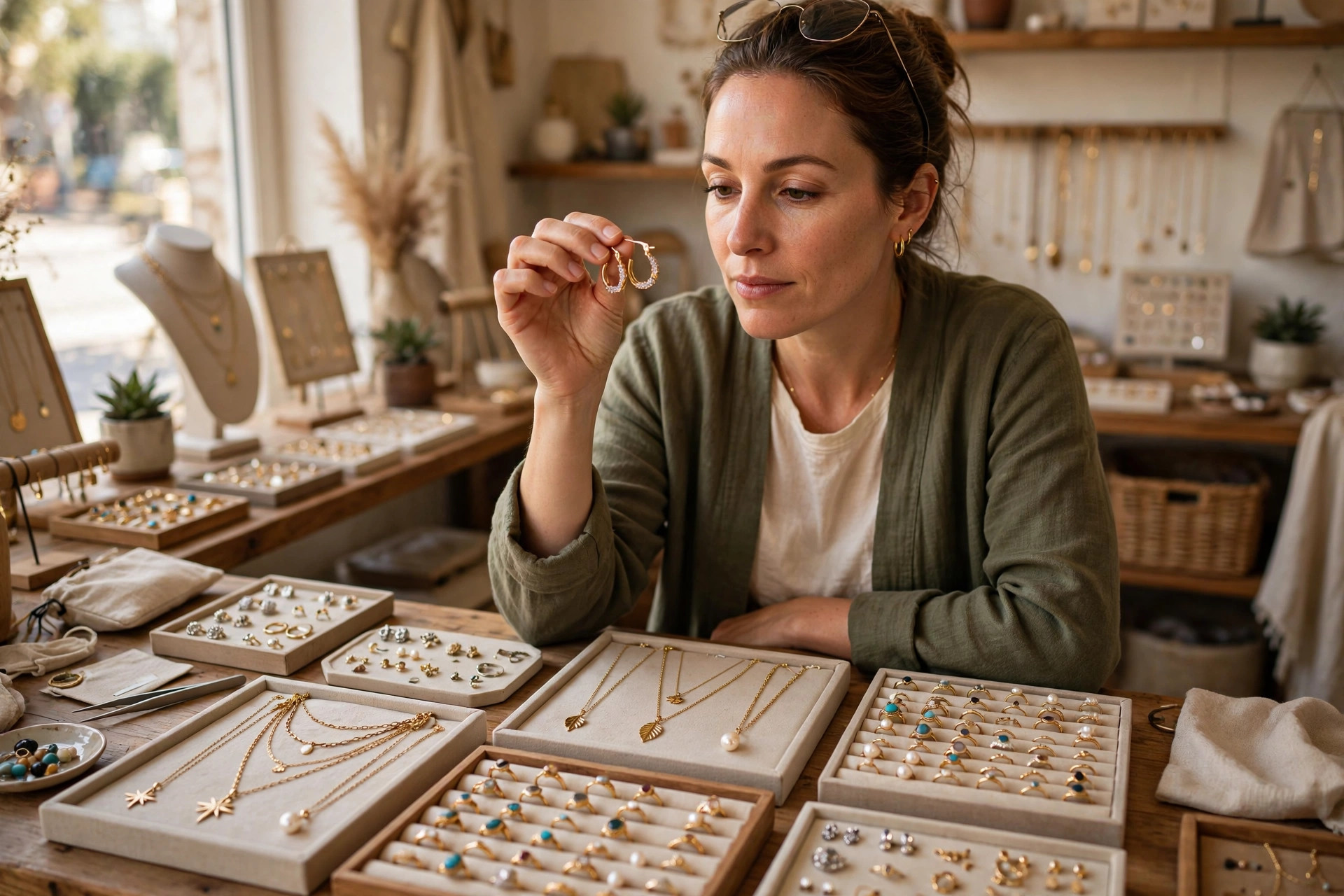
[IMAGE 2: Close-up of stainless steel earrings and pendant necklaces showing fashion jewelry wholesale pricing tiers]
How to Start Reselling: A 6-Step Launch Plan
Six moves to launch your wholesale fashion jewelry resale business. Idea to first sale, in order.
Step 1: Pick One Lane
The wholesale fashion jewelry resellers who win focus. The ones who list 500 random SKUs? They drown — in inventory, indecision, in dead stock.
Pick a lane.
Minimalist / dainty — clean lines, thin chains, small studs. Huge on Instagram and Pinterest. Low competition if you niche down hard.
Boho / festival — chunky stones, fringe, bold colors. Seasonal spikes around spring and summer festivals.
K-fashion — fast-moving trends straight off Korean TikTok. High velocity, short shelf life. You’ll reorder constantly.
Vintage / art deco — specific aesthetic, loyal buyers, less price sensitivity.
Personalized — initials, names, zodiac signs. Higher margins because customers can’t price-compare a name.
Men’s jewelry — rings, chains, bracelets. Underserved, growing fast, less competition.
Before you commit to any of them, pull up Google Trends. Five-year view. Flat or declining line? Walk away — no matter how much you personally love the aesthetic. Your taste doesn’t pay the bills. Demand does.
Then Vet Suppliers Like Your Money Depends on It
Because it does.
Don’t click “buy” on the first wholesale fashion jewelry listing on Alibaba that looks shiny. I skipped vetting once — wanted to save an afternoon. Ended up with 300 tarnished bracelets and a supplier who vanished off the face of the earth. Poof. Gone.
Learn from my stupidity. It’s free.
The Questions I Ask Before a Dollar Moves
Generally, I give every wholesale fashion jewelry supplier the same treatment now. A little interrogation I do before a single dollar moves.
It starts simple: are you the factory, or a trader? Just ask. Straight up. A real factory answers in ten seconds. If they dance around it — “we have cooperated factories,” “we are a comprehensive supplier” — that’s your answer. Walk.
Then I ask about MOQ. Not the number on the listing. The real one. Can I start with fifty pieces? Twenty? If they won’t budge below 500 before they even know my name, we’re not a fit. Not yet, anyway.
Samples come next. Free? Paid? Refundable if I place a bulk order? Here’s what I’ve learned: suppliers who charge for samples but credit it back on your first order — those are usually the serious ones. Suppliers who won’t send samples at all? Believe what they’re telling you.
In addition, certifications matter more than people think. Sedex. BSCI. ISO. Product-level stuff like CE. Look, no certs doesn’t automatically mean a bad supplier — some great small factories never bothered. But certs mean verifiable. When I can’t fly to Guangzhou to shake someone’s hand, I’ll take verifiable.
I also ask for references. Real buyers. Not their cousin’s Etsy shop — actual wholesale fashion jewelry customers I can message. The good suppliers hand these over without blinking.
The One People Forget: Response Speed
And the last one people forget: response speed. Email them a question. Time it. Three days for a quote? Imagine a quality crisis at 2 AM with a container on the water.
Pass.
Order Samples Like Your Business Depends on It
Most importantly, always — always — test before bulk.
Order 10–20 different wholesale fashion jewelry pieces. Then put them through hell.
Plating first. Ask for the spec sheet — PVD should run at least 0.03μm. A legit supplier has this ready before you finish the sentence. If they go quiet or say “our plating is very good quality,” that’s not a spec. That’s a wish.
Then the welds. Check every jump ring, every clasp, every post — run your fingernail over them. Rough welds snap — and they always snap after your customer leaves a five-star review, never before. Ask me how I know. Actually don’t. It still stings.
Allergy safety next, especially if your buyers have sensitive skin. Get nickel release reports. One allergic-reaction review doesn’t just kill a listing — it follows your shop around. People screenshot that stuff.
And the water test. Soak a piece for 48 hours. Just leave it in a glass on your counter. Tarnishing? Discoloration? Green tinge? Better to find out in your kitchen than in a customer’s inbox three weeks later.
The rule I tattooed on my brain after that bracelet disaster: a supplier who won’t send samples before a bulk order is telling you exactly who they are.
Believe them. Walk away.
Choose One Channel (Not Five)
|
Channel |
Best For |
Watch Out For |
|---|---|---|
|
Etsy |
Handmade-adjacent, gifts, personalized |
6.5% transaction fee, SEO matters |
|
Amazon FBA |
Volume, Prime buyers |
15% referral fee, brutal competition |
|
Shopify / WooCommerce |
Brand control, high margins |
You drive ALL traffic yourself |
|
TikTok Shop |
Impulse buys, fast-moving trends |
Content treadmill never stops |
|
eBay |
Clearance, one-off pieces |
Lowest prices, bargain-hunter buyers |
That table up there? Pick one row. Just one.
Clearly, I know the temptation — Etsy and Amazon and TikTok Shop, all at once, go go go. That’s how beginners burn out by month two. Each channel is a full-time job to learn: its algorithm, its buyers, its fee traps. Master one. Get to consistent sales. Then expand.
The channel you pick also shapes your wholesale fashion jewelry sourcing. A $2.50 pendant thrives on TikTok Shop and dies on Amazon FBA fees. Choose the channel first, source second — not the other way around.
Do the Math Before You Order Anything
Not in your head. On paper. Or a spreadsheet. Somewhere the wholesale fashion jewelry numbers can’t wriggle away.
Start with landed cost per piece. That’s unit price plus shipping plus duties plus packaging. All of it. Not the number you wish it was — the real one, with every ugly surcharge included.
Then channel fees. Etsy’s 6.5%. Amazon’s 15%. PayPal’s 3–5%. These come off the top whether you remembered to budget for them or not. I “forgot” Amazon’s referral fee on my second product launch. That was a fun surprise. Don’t be me.
And sell-through — be honest with yourself. Assume 70% in month one, declining after. Not 100%.
Never 100%.
Try this: if the math doesn’t work on a spreadsheet, it won’t work in real life. And remember — the spreadsheet is the optimistic version. Reality charges extra.
Scale: From $500 Months to $50K Months
Sales are validating. Now what?
Repeat buyers. That’s the first lever, and honestly the only one that matters early. Email follow-ups. A little loyalty discount. Early access to new jewelry arrivals — make them feel like insiders. The math nobody talks about: a customer who buys twice is worth five one-timers. Five. Retention isn’t a nice-to-have in wholesale fashion jewelry. It’s the business.
Second lever: SKU expansion. She bought the necklace? The matching earrings are sitting right there. One click. Average order value climbs and you didn’t spend a cent on new traffic. This is why I tell people to think in sets, not singles, when sourcing.
Then the long game — private label. Custom packaging. Your name on the box. A brand story that isn’t “cheap jewelry from the internet.” Suddenly you’re not competing on price anymore. Higher prices. Stickier customers. Actual brand equity instead of a race to the bottom.
The trajectory I keep seeing: $5K/month by month six, $20–50K/month by month 12–18.
Not guaranteed. Anyone who guarantees it is selling you a course.
But when sourcing and channel fit are right? That’s the shape of the curve. I’ve watched it happen enough times to trust the pattern.
3 Costly Mistakes Beginners Should Avoid
In general, I’d rather you learn these from reading than from your bank account. Every one of these cost someone I know real money.
I know a woman — let’s call her Lisa — who found a supplier on Alibaba selling plated necklaces at $0.60 a piece. Sixty cents. She ordered 2,000 pieces without blinking. The photos looked great. The price was “unbeatable.”
Consequently, two weeks after her customers got them, the green started showing. Not on all of them — just enough. Her Etsy shop went from 4.9 stars to 3.2 in a month. She lost $4,000 on inventory and probably twice that in reputation. The cheapest supplier ships the cheapest quality. Almost like there’s a connection.
Then there’s the hidden-cost trap. I fell into this one myself, so no judgment. My first real bulk order — I did the math on unit price, felt great about the margin, placed the order. Then the freight bill came. Customs followed. And I still needed boxes that didn’t look like trash. By the time everything landed, my per-piece cost was 35% higher than the “price” I’d budgeted around. Air freight, duties, packaging — they don’t announce themselves. They just quietly add 20–40% while you’re not looking. If your margin math only uses the factory price, you’re not calculating.
You’re daydreaming.
And the third one — skipping samples. A guy I know (who shall remain nameless because he still gets mad about it) ordered 1,000 pairs of “titanium” earrings without testing a single pair. They were plated brass. One customer had an allergic reaction and left a detailed review with photos. Game over for that listing. His shop never recovered.
Ten dollars in samples. That’s all it would have taken.
Really. Don’t skip it.
Wholesale Fashion Jewelry FAQ
People ask me these constantly. Here are the honest answers.
“What’s the minimum order quantity to start?”
Depends who you ask. Factory-direct brands like JewelryBund let you start with as few as 50 pieces per style. Alibaba factory listings typically want 100–500. Trading companies sometimes go as low as 20. The real question isn’t “what’s the minimum” — it’s “what’s the minimum where the unit price still makes sense?” Sometimes 100 pieces at $0.80 beats 20 pieces at $2.00. Do the math.
“How do I know a supplier isn’t going to scam me?”
You verify. Every time. No shortcuts — and honestly, this is the question that tells me someone’s serious about wholesale fashion jewelry versus someone who’s about to lose money.
Pull their business license. Ask for Sedex or BSCI or ISO certs — real ones you can look up, not a PDF they made in Photoshop. Get them on a video call and ask to see the factory floor. Not the showroom. The floor. Order samples before anything else.
And check reviews, but read them like a detective. Five hundred perfect reviews posted in the same week? That’s not a supplier. That’s a marketing budget.
I got burned once by skipping this. Never again.
“What kind of margins are we talking?”
The honest range: 60–300% markup over your wholesale fashion jewelry cost. Sounds insane until you see the actual numbers — $1.20 in, $4.80 out is completely normal in the wholesale fashion jewelry business.
But. And this is the part the gurus skip. After shipping, packaging, platform fees, marketing, returns, and the occasional disaster — your net margin lands around 15–40%. Still excellent. Just don’t walk in expecting to triple your money with zero costs. That’s not a business plan. That’s a fantasy.
“Can I just dropship? I don’t want inventory in my apartment.”
Yes. Dropshipping wholesale fashion jewelry works fine. No boxes in your living room. No 2 AM packing sessions.
However, the catch is delivery time. Your wholesale fashion jewelry customers expect their stuff in 5–10 days now — that’s the Amazon-trained baseline. So you need a supplier who does white-label packaging (your brand, not theirs) and ships fast, ideally from a warehouse near your buyers. A supplier shipping ePacket from Shenzhen with a 25-day window will murder your reviews. Ask about fulfillment before you list a single product.
“How long does shipping from China actually take?”
Three speeds, three prices. Pick your pain.
Sea freight: 25–40 days. Dirt cheap on big orders — we’re talking cents per piece. But you need to plan a month ahead, minimum. Forget “I need it next week.”
Air freight: 7–15 days. The middle ground most growing sellers use.
Express — DHL, FedEx: 3–7 days. Fastest. Also the fastest way to watch your margin evaporate. I use express for samples and emergencies only. If you’re express-shipping bulk inventory regularly, something’s wrong with your planning.
“Is this stuff hypoallergenic? Waterproof?”
It depends entirely on what it’s made of. Anyone who gives you a blanket “yes” is lying or clueless.
PVD-coated stainless steel? Titanium steel? Those handle water fine and rarely cause reactions. I wear steel pieces in the shower. No issues.
Plated brass? Different story. Water will kill the plating, and nickel-sensitive buyers will react. Not maybe. Will.
So test everything yourself, and label honestly. “Waterproof” is a claim. “Water-resistant” is a claim. Get it wrong and you’re not just losing a customer — in some markets you’re breaking consumer protection law. Not worth it.
“What about returns? What if the quality’s bad?”
For this reason, build a 2–3% replacement reserve into your pricing from day one. Not “if” you need it. When.
Good wholesale fashion jewelry suppliers offer 30-day defect guarantees — get this in writing before you order, not after something goes wrong. And on your end? Post a clear return policy on your shop. Visible. No fine print games.
A clean return policy doesn’t cost you sales. It makes sales. People buy more wholesale fashion jewelry when they’re not scared of getting stuck.
Ready to Start Your Wholesale Fashion Jewelry Business?
Overall, you’ve got the full picture now — what wholesale fashion jewelry costs, where the traps are, how to start without lighting money on fire.
So here’s my suggestion: don’t “think about it” for another three months. Open a wholesale fashion jewelry catalog. Pick 10–15 pieces in one niche. Order the samples. Run the four quality checks from the sampling section above.
Total risk: maybe $100 and a week of your time. Cheapest business education you’ll ever buy.
The wholesale fashion jewelry business rewards two things: patience and good sourcing. Get those right and the rest genuinely follows. Go.
